Day 1 — Local Inference: The spec sheet called it
Unit 1.1 from Curriculum. Lab notes and polished narrative interwoven — predictions were written in ink before anything ran.
The question: decode is supposedly memory-bandwidth-bound (Inference, Transformer Inference Basics). Can my laptop’s spec sheet — no benchmark, no code — predict its token rate before I run anything? It did: to 13% on the absolute number and 0.5% on the context-scaling law.
Setup
- Apple M4, 24 GB unified memory, 120 GB/s bandwidth (Apple spec). Unified memory means CPU and GPU (Metal) share one bus — one number predicts both.
- llama.cpp (brew), Metal backend. Model: Qwen3-8B, Q4_K_M GGUF — 8.19B params, file = 4.68 GiB = 5.03 GB.
- Instrument:
llama-bench—pp512= prefill tok/s (512-token prompt, batched),tg128= decode tok/s (128 tokens, one at a time). 5 reps each + warmup, mean ± σ.
The math (predictions in ink, before running)
Every decode step reads the entire model once (plus the KV cache), so the ceiling is:
predicted decode tok/s ≈ memory bandwidth ÷ bytes read per token ≈ bandwidth ÷ model file size (at short context)
Decode (bandwidth roofline). Batch-1 generation touches every weight once per token with zero reuse — the cost is streaming the model across the bus, not the FLOPs. The ink: Qwen3-8B ≈ 8.2B params, Q4_K_M ≈ 4.2 bits/weight → 8.2B × 0.6 bytes ≈ ~5 GB file. So:
decode ceiling = bandwidth ÷ bytes per token = 120 GB/s ÷ 5.03 GB = 23.9 tok/s (ink said “120 ÷ 5 = 24”)
KV cache (the context tax). Each token of context adds cached K/V that decode must also read every step:
bytes/token of context = 2 (K+V) × 36 layers × 8 KV heads × 128 head_dim × 2 bytes (fp16) = 144 KB
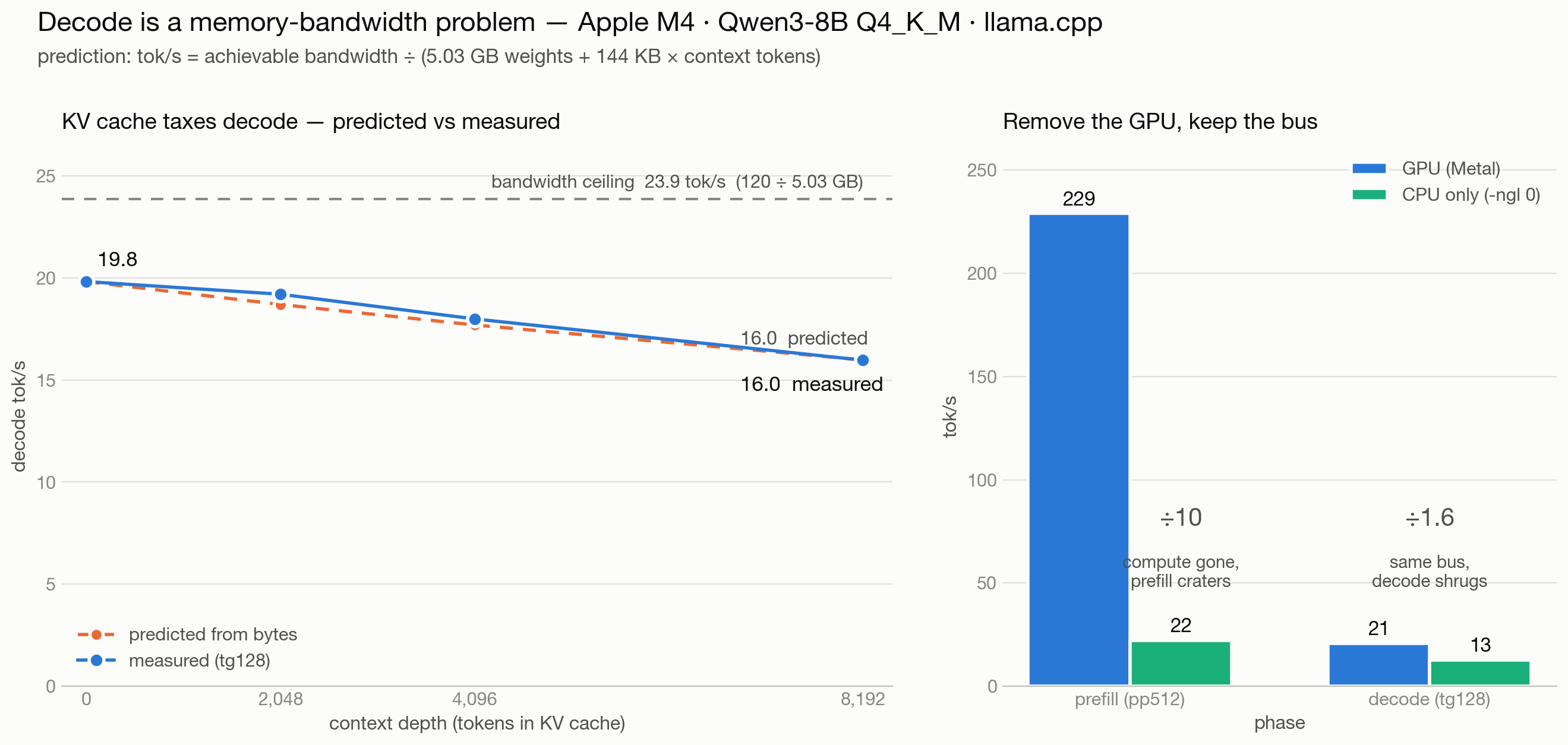
At depth d, bytes per decode step = 5.03 GB + d × 144 KB → at 8k: +1.18 GB → 6.24 GB → predicted slowdown to 81% of baseline (~16 tok/s). (The 8 is KV heads — GQA: 32 query heads share 8 K/V heads, a 4× cache compression.)
Prefill. The ink guess: “should be much faster — compute-bound, parallel over the prompt; 10–20× decode, grab the average → 360 tok/s.” That guess was folklore, and it missed — the proper derivation (done after the miss) is a compute roofline: a forward pass costs ≈ 2P FLOPs/token = 16.4 GFLOPs. Batched over 512 tokens, weights are reused — the bus stops mattering and the M4’s ~4.4 TFLOPS takes over:
prefill ceiling = 4.4e12 ÷ 16.4e9 ≈ 270 tok/s
Same game, other spec: the machine does ~37 FLOPs per byte of bandwidth (4.4 TFLOPS ÷ 120 GB/s); decode offers it ~2 FLOPs per byte, prefill offers hundreds. That ratio is the prefill/decode gap.
Steps
-
brew install llama.cpp - Grab a Q4 8B model — llama.cpp pulls straight from HF:
llama-bench -hf ggml-org/Qwen3-8B-GGUF:Q4_K_M(orhf downloadfirst and pass-m) - Baseline bench:
llama-bench -m <model> -p 512 -n 128→ notepp(prefill tok/s) andtg(decode tok/s) - Context depth sweep:
llama-bench -m <model> -n 128 -d 0,2048,4096,8192— watch decode degrade as the KV cache adds bytes per token - Chat with it once (
llama-cliorllama-server) — feel TTFT vs stream rate; this is the thing the numbers describe - Compare predicted vs measured; compute the % error
- Bonus runs: Q8 quant (halves-the-bytes logic in reverse) and CPU-only (
-ngl 0) — both written up below
Measurements (raw)
| Run | Prefill tok/s | Decode tok/s | Notes |
|---|---|---|---|
| baseline (p512/n128) | 228.94 ± 0.10 | 20.80 ± 0.05 | quiet machine; ceiling 23.9 → 87% |
| d=2048 | 195.62 ± 0.65 | 19.20 ± 0.28 | sweep-run baseline was 19.82 ± 0.38 (background load) |
| d=4096 | 179.63 ± 0.72 | 17.99 ± 0.26 | predicted (re-anchored) 17.7 → 1.6% err |
| d=8192 | 154.57 ± 0.84 | 15.97 ± 0.06 | predicted 16.05 → 0.5% err; 80.6% of baseline vs 81% predicted |
| Q8_0 (p512/n128) | 226.70 ± 7.47 | 12.52 ± 0.08 | 8.71 GB file; ÷1.66 vs file-ratio 1.73; 91% of its 13.8 ceiling |
| CPU only (-ngl 0) | 22.15 ± 1.74 | 12.69 ± 1.36 | prefill ÷10 (compute gone); decode ÷1.6 → CPU pulls only ~64 GB/s of the bus |
Efficiency: measured decode ÷ predicted ceiling = 20.80 ÷ 23.9 = 87% of the theoretical bus limit. (Prefill: 228.94 ÷ ~270 compute ceiling = 85% — same story, other roofline.)
Predictions vs measurements
Predictions scored against the untouched ink above:
| Quantity | Predicted | Measured | Verdict |
|---|---|---|---|
| Model file size | ~5 GB | 5.03 GB | ✅ |
| Decode (short ctx) | ≤ 23.9 tok/s ceiling | 20.80 ± 0.05 | 87% of the bus limit |
| Prefill | guessed 360 tok/s | 228.94 ± 0.10 | ❌ miss — see below |
| Decode @ 8k vs 0 | 81% of baseline | 80.6% | 0.5% error |
Context sweep (-d 0,2048,4096,8192), predictions re-anchored on that run’s baseline since we’re testing the scaling law:
| depth | bytes/token | predicted tok/s | measured tok/s | error |
|---|---|---|---|---|
| 0 | 5.03 GB | 19.82 (anchor) | 19.82 ± 0.38 | — |
| 2,048 | 5.33 GB | 18.7 | 19.20 ± 0.28 | 2.7% |
| 4,096 | 5.63 GB | 17.7 | 17.99 ± 0.26 | 1.6% |
| 8,192 | 6.24 GB | 16.05 | 15.97 ± 0.06 | 0.5% |
The prefill miss is the honest content. “10–20× decode” was folklore, and grabbing the midpoint (→360) ignored that 360 would exceed the compute roofline (270). Derived properly, measured prefill = 228/270 = 85% of the compute ceiling — the same ~85–87% engine efficiency in both regimes, each against its own roof. Lesson: don’t guess multipliers, derive the second roofline too.
Bonus finding: prefill also degrades with depth (228 → 154 by 8k, −32%) — but for a different reason than decode. Decode pays for context in bytes (KV cache reads); prefill pays in FLOPs (each prompt token attends to all d cached tokens — the parameter-free QK^T/AV math is ~590k × d FLOPs/token, ~30% on top of 2P at 8k). Same cause, two currencies.
Caveats collected along the way
- GiB ≠ GB. llama.cpp reports 4.68 GiB; bandwidth specs are decimal GB/s. 4.68 GiB = 5.03 GB — a silent 7% error if skipped.
- Q4_K_M ≈ 4.9 bits/weight effective, not 4. Block scales + the “_M” mixed recipe (sensitive tensors kept at Q6_K). File-size ratio, not nominal bit ratio, is what predicts speed ratios — Q8/Q4 file ratio is ~1.73×, not 2×.
- The KV cache stays fp16 even in a Q4 model — only weights are quantized (llama.cpp default).
- 2P FLOPs/token omits the parameter-free attention math. Fine at short context (~2% at d=0), ~30% extra at 8k, dominant at ~28k+. “Attention is the bottleneck” is a claim about scaling, not the constant.
- tg128 is synthetic: starts from an empty cache, feeds arbitrary tokens, no sampling — the forward pass costs the same regardless of token identity, so it cleanly isolates the engine.
- Run-to-run variance is real: baseline was 20.80 ± 0.05 on a quiet machine, 19.82 ± 0.38 with background load. Watch σ; it’s the honesty meter.
- Expect 70–90% of any roofline, not 100% — memory-controller overhead, non-weight work. Apple’s unified memory is at the high end.
Q8 experiment
Same logic, reversed: Q8_0 ≈ 8.5 bits/weight → ~8.7 GB file → decode should scale down by the file-size ratio (1.73×), not the nominal bit ratio (2×); prefill ~unchanged (FLOPs don’t care how weights are stored).
| Quantity | Predicted | Measured | Verdict |
|---|---|---|---|
| File size | ~8.7 GB (8.1 GiB) | 8.71 GB (8.11 GiB) | ✅ |
| Decode | ~11.5–12.0 tok/s | 12.52 ± 0.08 | 91% of the 13.8 ceiling |
| Prefill | ~228 tok/s | 226.70 ± 7.47 | ✅ unchanged — compute-bound confirmed |
“Does decode halve?” No — 1.66×, and the miss decomposes cleanly. Nominal bits promised 2×; real file bytes promised 1.73× (Q4_K_M is ~4.9 bits effective); measured was 1.66×. The residual is format efficiency: Q8_0 hit 91% of its roofline vs Q4_K_M’s 87% — plain 8-bit blocks dequantize more cheaply than Q4_K’s nested super-block scales. Bytes predict the ratio to first order; format overhead is the second-order term. Practical reading: quantization buys slightly less speedup than the bytes alone promise, and the cheaper the format’s decode path, the closer you run to the bus.
CPU control experiment (-ngl 0)
The falsifiable test: switching off Metal removes most of the compute but keeps the exact same memory bus (unified memory). If decode is bandwidth-bound, it should barely care; prefill should crater.
| Phase | GPU (Metal) | CPU only | Drop |
|---|---|---|---|
| Prefill | 228.94 | 22.15 ± 1.74 | ÷10 — compute-bound confirmed |
| Decode | 19.82–20.80 | 12.69 ± 1.36 | ÷1.6 — see below |
Prefill collapsed 10× exactly as predicted. Decode dropped more than “barely” — and inverting the formula explains it. Compute the bandwidth each backend actually pulled:
GPU: 19.82 tok/s × 5.03 GB ≈ 100 GB/s (83% of spec)
CPU: 12.69 tok/s × 5.03 GB ≈ 64 GB/s (53% of spec)
Decode is still bandwidth-bound on CPU — cores that do 22 tok/s of prefill compute aren’t compute-limited at 12.7 tok/s of decode. The refinement: “the bus is 120 GB/s” ≠ “any client can pull 120 GB/s.” A 4-core CPU cluster has its own link into the memory fabric (~60–65 GB/s achievable); the GPU’s dozens of parallel memory-hungry cores extract far more. Spec-sheet bandwidth is the chip’s ceiling; each compute unit has a lower, achievable one. Final formula: tok/s = achievable bandwidth ÷ bytes per token — and achievable depends on who’s asking. (Untested: -t 8 — do the efficiency cores pull more bandwidth or straggle? Also note the ±1.36 stddev, ~11% — noisier than every other run.)
X post — final draft (single long post, chart attached)
Day 1/45 of Inference Engineering: Basic Local Inference
Thanks to @maxxfuu & @mohitwt_ , I’ve been inspired to take on this challenge and hopefully you guys can learn alongside me.
I’ve decided to start easy and just get Qwen3 8B running locally on my M4 24GB MacBook Pro (llama.cpp) — with one rule: predict every number from the spec sheet before running anything.
The theory: generating a token means reading every weight once. No reuse at batch 1. So decode isn’t a compute problem — it’s a memory-bandwidth problem, and the ceiling is just division:
120 GB/s (M4 bus) ÷ 5.03 GB (Q4 file) ≈ 24 tok/s
Measured with llama-bench: 20.8 — 87% of the theoretical bus limit, predicted before a single token ran.
Three more predictions, all from paper math:
• KV cache adds 144 KB per token of context (2 × 36 layers × 8 KV heads × 128 dims × fp16, straight from config.json) → predicted decode at 8k context falls to 81% of baseline. Measured: 80.6%.
• Q8 quant: the file is 1.73× bigger than Q4, so decode should be 1.73× slower — not the 2× the nominal bits promise. Measured: 1.66×.
• The control: CPU-only (-ngl 0), same unified-memory bus, most of the compute gone. Prefill cratered 10×. Decode barely moved (÷1.6). Decode never needed the FLOPs.
What surprised me: my prefill guess missed by 60% — until I derived the compute roofline too (2P FLOPs/token ÷ 4.4 TFLOPS ≈ 270 tok/s), and the same ~85% efficiency fell out of both regimes. Two phases, two spec-sheet numbers, one engine.
The formula for your own machine: decode tok/s ≈ memory bandwidth ÷ model file size. That’s it.
Day 2: renting a real GPU and standing up my own endpoint.
[attach: xdoi-day1-decode-vs-context.png]
What surprised me — candidates
- The 0.5% error at 8k: a number derived from
config.jsonfields showed up on a stopwatch. - The CPU run breaking the naive theory in an instructive way: decode dropped 1.6× not because bandwidth stopped mattering, but because 4 cores can only pull half the bus. “Achievable bandwidth” became the day’s most refined concept.
- Prefill folklore (“10–20×”) vs deriving the compute roofline — the miss that taught the most.
- Prefill degrading more than decode with depth (FLOPs tax vs bytes tax).
dflash-/dspark-draft models in the wild: speculative decoding exists because of everything above — decode wastes 95% of the compute, so fake a batch.